Introduction
Search engine optimization (SEO) content writing is one of the most valuable skills in modern digital marketing. Whether you are a blogger trying to grow your audience or a professional content writer offering services to clients, understanding how to write content that ranks on Google while genuinely helping readers is essential.
Many people confuse SEO writing with keyword stuffing or technical trickery. That is not what this article teaches. Instead, you will learn the fundamentals of creating helpful, well-structured, and search-friendly content that performs well over time.
This guide covers everything from basic definitions to advanced best practices. By the end, you will know exactly how to research keywords, structure articles, optimize on-page elements, and promote your work effectively.
Let us begin with the six core things every blogger and content writer needs to know about SEO content writing.
What’s SEO Content Writing? 6 Things to Know
Before we get into all the details it is an idea to start with a simple definition. SEO content writing is when you write things that are meant to get people to visit your website from search engines like Google, Bing and Yahoo. This type of writing is different from kinds of writing because SEO content needs to be easy for people to read and also have special things that help search engines like Google understand what it is, about and decide where it should show up.
Here are the six main parts of SEO content writing.
1. Content for Search
Writing for search engines is about making content that brings people to your website. When people plan what they will write about they usually want to get more people coming to their site from search engines. For instance if someone writes a blog post called “How to Start a Food Blog” and someone types that into Google then that blog post will show up.
That is what we mean by content for search engines.. People coming from search engines is not the only way to get visitors. If you share your blog post on media you will also get people coming to your site directly and that is just as good. The main thing to remember is that content, for search engines needs to answer the questions that people are actually asking.
To make content that people will find when they search you need to understand why people are searching for something. This is called search intent. Search intent is the reason someone is searching for something. If someone searches for ” coffee makers” they want to know what coffee makers are good. If someone searches for “how to fix a coffee maker” they want to know how to fix their coffee maker. So you need to make sure your content is what people are looking for that is the rule of writing for search engines.
2. Decent Writing

You cannot put a lot of keywords into writing and think that people will come to your website. This used to work a time ago around the early 2000s but it does not work like that anymore. So why is that? It is because search algorithms have gotten a lot better. Google now likes content that shows it was written by someone who really knows what they are talking about and that the writer is trustworthy and an expert. They call this -E-A-T, which stands for expertise, authoritativeness and trustworthiness and Google looks for these things when it decides what to show people.
What does decent writing mean in practical terms? It means content that is:
- Correct in terms of facts and spelling
- Well-organized with clear headings and paragraphs
- Easy to read without confusing jargon or run-on sentences
- Valuable to the reader, not just optimized for bots
Using language models like ChatGPT is okay as long as you are careful with what you write. These models can help you make a plan or write a draft but you need to check everything to make sure it is correct and sounds like a real person wrote it. If you have spelling mistakes it is a problem for people who read your work and for search engines.
One small mistake in the title of your piece can make people trust you less.
To avoid making mistakes that’re embarrassing you should use a good spelling checker. You can find a tool at https://spelwise.com/. This tool is free and it helps people who write blogs and articles find mistakes like typos, missing letters and words that are repeated before they publish their work. Writing that is clean and easy to read is very important if you want to be successful with search engines. ChatGPT and other language models, like ChatGPT are tools that can help you. You need to use them carefully and always check your work.
3. For the Love of Your Audience

Knowing your audience is super important like knowing what you’re talking about. When you’re creating content for people you don’t know it’s like buying a gift for a stranger. You might get it wrong. Waste your time.
Some folks say that with AI making content is totally different now.. Really AI just reminds us that good content is about your audience first. It’s not, about trying to impress search engines. Your audience comes first search engines.
To stand out and get large language models and search engines to notice you, try the following:
- Tailor content to a specific ideal client rather than trying to appeal to everyone
- Create specialization by focusing on a niche instead of covering broad topics superficially
- Share insights that are not publicly available elsewhere, such as original survey data or personal experiences
- Offer an original opinion instead of rehashing what competitors have already said
Bloggers and content writers who prioritize their audience over algorithms build loyal readerships that return again and again. That loyalty signals quality to search engines, creating a virtuous cycle of higher rankings and more traffic.
4. Keywords
Keywords remain a ranking factor and continue to serve as the gateway to search traffic. Until that changes, every web page needs a focus keyword or key phrase. However, keyword stuffing — repeating the same word unnaturally — is still a very bad idea.
Modern SEO requires strategic keyword placement. Your primary keyword should appear in:
- The page title (H1)
- The first 100 to 150 words of content
- At least one subheading (H2 or H3)
- The meta description
- The URL slug
Beyond placement you need to do proper keyword research. Guessing what people search for doesn’t work well.
You should use tools to find out what your target audience is actually typing into Google.
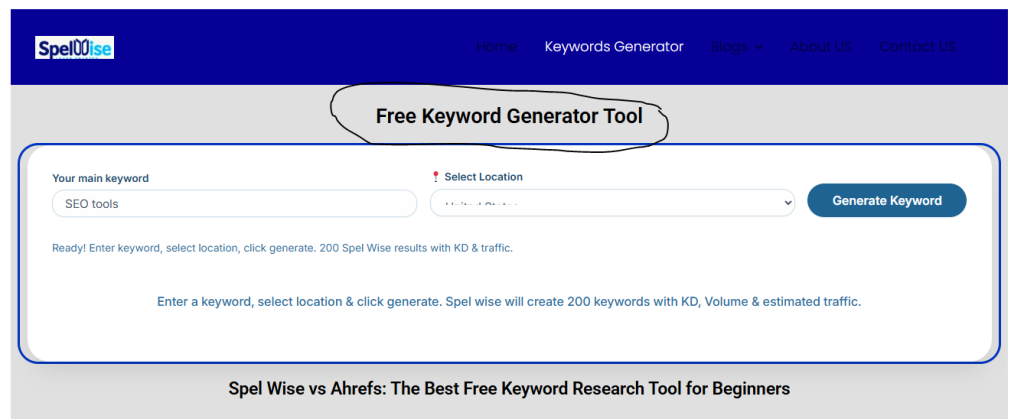
One great free tool is the Free Keyword Generator Tool at https://spelwise.com/free-keywords-generator/.
This tool helps bloggers and content writers like you find keywords that’re relevant to their work.
You do not have to pay for subscriptions to use it.
To use the tool simply enter a topic. It will give you keyword ideas and estimates of how often people search for them.
The Free Keyword Generator Tool is really helpful, for finding the keywords.
You can use it to make your content better.
Effective keyword research saves hours of guesswork and ensures you write about topics that already have demand.
5. On-Page SEO

Good writing is not enough to get you to the top of Google. You also need to make your website look nice. Be easy to use. This helps people and search engines like Google find your website.
The way you write for a website is different from the way you write a book. When you read a book you expect blocks of text.. When you look at a website you want to be able to scan it quickly and see what is important. This is really important for people who have trouble reading or cannot see well. Website visitors, like website content that’s easy to scan with clear headings and short paragraphs. This makes it easy for people to find what they are looking for on the website.
Here are key on-page SEO elements every blogger and content writer must master:
- Keyword placement – Using your target keyword in strategic locations without overdoing it
- Heading hierarchy – Using H1 for the main title, H2 for main sections, and H3 for subsections
- URL structure – Creating short, descriptive URLs that include your target keyword
- Optimized meta titles and descriptions – Writing compelling, clickable snippets that appear in search results
- Internal links – Linking to other relevant pages on your own website to distribute authority
On-page SEO also includes technical elements like image alt text, page load speed, and mobile responsiveness. While those factors involve more than just writing, content writers should be aware of them because poorly optimized images or bloated code can undermine even the best-written articles.
6. Off-Page SEO
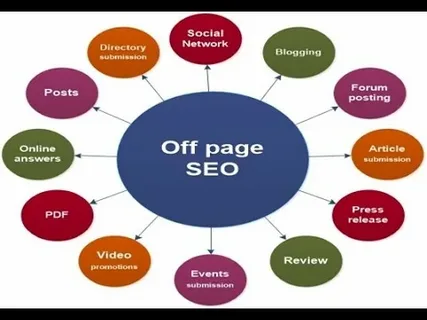
When you share your blog post on media that is what people call off-page SEO. Off-page SEO is when you do things to promote your website. You do not do them on your website. The important thing for off-page SEO is the backlink. A backlink is when another website puts a link to your website on their website.
Backlinks are like when someone says your website is good. When a big website with a lot of visitors puts a link to your blog search engines think that means your blog is trustworthy and has good things to say. Getting backlinks takes a long time and a lot of work. You cannot just pay for them because that can get you in trouble. Off-page SEO and backlinks are very important, for your website.
Effective off-page SEO strategies include:
- Guest posting on authoritative websites in your niche
- Sharing content on LinkedIn, Twitter, Facebook, and other social platforms
- Participating in online communities like Reddit and Quora (with valuable contributions, not spam)
- Creating linkable assets such as original research, infographics, or comprehensive guides
- Reaching out to other bloggers and website owners to suggest relevant resources
Off-page SEO amplifies the value of your on-page efforts. Even the best article will struggle to rank if no one links to it or shares it. Consistency in promotion is just as important as consistency in publishing.
Why Is SEO Writing Important?
Many new bloggers and freelance writers ask why SEO writing matters so much. The answer is straightforward: without SEO, your content is invisible.
Consider these facts:
- Over 90% of web pages get zero organic traffic from Google
- The first organic search result receives nearly 30% of all clicks
- 75% of users never scroll past the first page of search results
SEO writing changes those odds in your favor. When you optimize your content properly, you increase the chances that your article appears on page one for relevant searches. That visibility translates into consistent, free traffic month after month.
For bloggers, SEO traffic reduces reliance on social media algorithms that can change overnight. For content writers, SEO skills command higher rates because clients understand the business value of ranking well. In both cases, SEO writing is not optional — it is essential.
Another reason SEO writing matters is cost efficiency. Paid advertising requires a continuous budget. Once you stop paying, traffic stops. SEO content, on the other hand, continues to bring visitors for years after publication. An article written and optimized today can generate traffic in 2028 without additional spending.
Why is SEO Writing Important?
Repetition helps reinforce critical points. SEO writing is important because it:
- Drives targeted traffic – People searching for specific terms are already interested in your topic
- Builds credibility – High Google rankings signal trustworthiness to users
- Provides long-term results – Unlike ads, SEO content compounds over time
- Supports all other marketing channels – SEO-optimized blog posts can be repurposed for email, social media, and video scripts
- Delivers measurable ROI – Tools like Google Analytics show exactly how much traffic and revenue each article generates
For freelancers and agencies, offering SEO writing services opens doors to higher-paying clients. Businesses understand that ranking on page one for commercial keywords can be worth thousands or even millions in revenue. They are willing to pay writers who understand how to make that happen.
What is the Difference Between SEO Writing and Content Writing?
| Aspect | Content Writing | SEO Writing |
| Primary focus | Reader value, engagement, storytelling, and building relationships | Search engine visibility + reader value (both equally important) |
| Keyword usage | Keywords are optional or incidental | Keywords are strategically researched and placed |
| Technical optimization | Minimal or none (no meta tags, URL optimization, etc.) | Includes meta titles, meta descriptions, URL slugs, heading hierarchy, alt text |
| Target audience | Existing audience (subscribers, followers, repeat visitors) | New audiences discovering content via search engines |
| Success measurement | Reader engagement (comments, shares, time on page) | Search rankings, organic traffic, click-through rates, conversions |
| Content format | Flexible (can be long essays, short social posts, internal newsletters) | Structured for search (clear headings, scannable paragraphs, lists) |
| Research required | Topic research for relevance and accuracy | Keyword research + search intent analysis + competitor analysis |
| Promotion strategy | Email, social media, direct sharing | Backlink building, outreach, plus standard promotion |
| Typical use cases | Brand storytelling, internal comms, email newsletters, creative writing | Blog posts, landing pages, product descriptions, help articles |
| Lifecycle | May have short-term relevance (news, updates) | Designed for long-term organic traffic (evergreen content) |
| Skill set required | Writing craft, creativity, voice | Writing craft + SEO tools + data analysis + HTML basics |
Quick Summary
Content writing is like cooking a delicious meal.
SEO writing is like cooking a delicious meal and making sure the restaurant has good signage, an easy-to-find location, and positive online reviews.
Both feed people. One also ensures people can find the food in the first place.
Not all content writing needs to be SEO writing (e.g., internal company newsletters). But public-facing blog posts, landing pages, and articles benefit greatly from SEO optimization.
This question confuses many beginners. The terms are related but not identical.
Content writing is a broad category that includes any written material created for an audience. Examples include blog posts, newsletter articles, white papers, case studies, social media captions, and video scripts. Content writing focuses primarily on the reader — providing value, telling stories, and building relationships.
SEO writing is a subset of content writing that specifically prioritizes search engine visibility. SEO writers still care about readers, but they also consider keyword research, on-page optimization, meta tags, internal linking, and other technical factors.
Here is a simple analogy. Content writing is like cooking a delicious meal. SEO writing is like cooking a delicious meal and also making sure the restaurant has good signage, an easy-to-find location, and positive online reviews. Both feed people. One also ensures people can find the restaurant in the first place.
Not all content writing needs to be SEO writing. Internal company newsletters or password-protected client reports do not need to rank on Google. But public-facing blog posts, landing pages, and articles absolutely benefit from SEO optimization.
As a blogger or content writer, learning SEO writing expands your skill set and makes you more valuable. You can still write creatively and emotionally. You just add a layer of strategic optimization on top.
Best Practices for Incorporating SEO In Your Writing
Now that the fundamentals are clear, it is time to explore specific best practices. The following sections provide actionable steps that bloggers and content writers can apply immediately.
Generate a List of Content Topics
Before writing anything, you need to know what to write about. Guessing leads to wasted effort. Instead, generate a list of potential topics based on actual search demand.
Start by brainstorming broad categories related to your niche. If you run a food blog, categories might include recipes, cooking techniques, kitchen tools, and nutrition. If you offer content writing services, categories could include SEO tips, freelance advice, grammar guides, and client management.
Once you have categories, dig deeper. What specific questions do people ask within each category? What problems do they need to solve?
Use a Q&A Tool
One of the most effective ways to generate content topics is to use a Q&A tool. These tools aggregate real questions that real people are asking online.
For example, you can use:
- AnswerThePublic – Generates visual maps of questions based on a seed keyword
- AlsoAsked.com – Shows questions that appear in Google’s “People also ask” boxes
- Reddit – Search relevant subreddits to see what users are struggling with
- Quora – Browse questions in your niche and note which ones have many followers or views
Q&A tools reveal search intent directly. When someone asks “how long does it take to rank on Google,” they want a timeline and actionable steps. Writing an article that answers that exact question gives you a strong chance of ranking for it.
Turn Your Topics Into Keywords
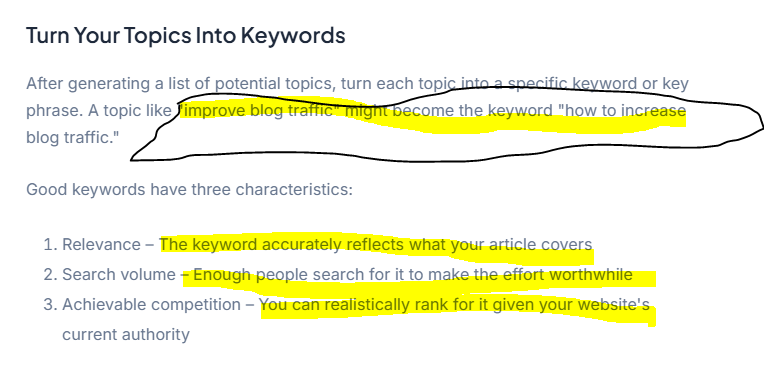
After generating a list of potential topics, turn each topic into a specific keyword or key phrase. A topic like “improve blog traffic” might become the keyword “how to increase blog traffic.”
Good keywords have three characteristics:
- Relevance – The keyword accurately reflects what your article covers
- Search volume – Enough people search for it to make the effort worthwhile
- Achievable competition – You can realistically rank for it given your website’s current authority
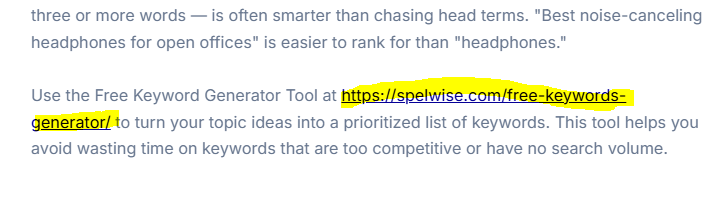
For bloggers with new or small websites, targeting long-tail keywords — phrases with three or more words — is often smarter than chasing head terms. “Best noise-canceling headphones for open offices” is easier to rank for than “headphones.”
Use the Free Keyword Generator Tool at https://spelwise.com/free-keywords-generator/ to turn your topic ideas into a prioritized list of keywords. This tool helps you avoid wasting time on keywords that are too competitive or have no search volume.
Outline Content To Match Search Intent
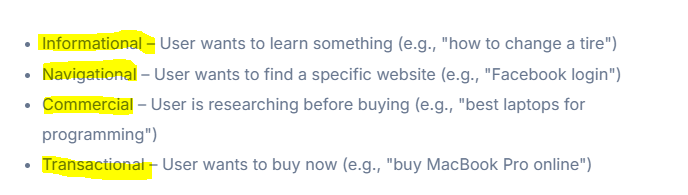
Once you have a target keyword, outline your content to match the search intent behind that keyword. Intent falls into four main categories:
- Informational – User wants to learn something (e.g., “how to change a tire”)
- Navigational – User wants to find a specific website (e.g., “Facebook login”)
- Commercial – User is researching before buying (e.g., “best laptops for programming”)
- Transactional – User wants to buy now (e.g., “buy MacBook Pro online”)
Most blog content targets informational intent. For informational keywords, your outline should educate first and sell later (if at all). Do not push a product in an article about “how to fix a leaky faucet.” The user just wants instructions.
Your outline should also address related subtopics that searchers expect to see. Search for your target keyword and analyze the top-ranking pages. What headings do they use? What questions do they answer? Use that research to build a comprehensive outline.
Write Comprehensive Content
Comprehensive content answers not just the primary question but also secondary questions that readers are likely to have. If you write about “how to start a podcast,” do not stop at equipment. Also cover recording software, hosting platforms, episode formatting, submission to Apple Podcasts, and promotion strategies.
Comprehensive content tends to rank better because it satisfies more user needs in a single visit. Instead of clicking away to another site for additional information, readers stay on your page longer. That longer dwell time signals quality to search engines.
However, comprehensive does not mean unnecessarily long. A 5000-word article that rambles is worse than a 1500-word article that covers everything concisely. Add length only when it adds value.
Use Your Keyword in Your Content
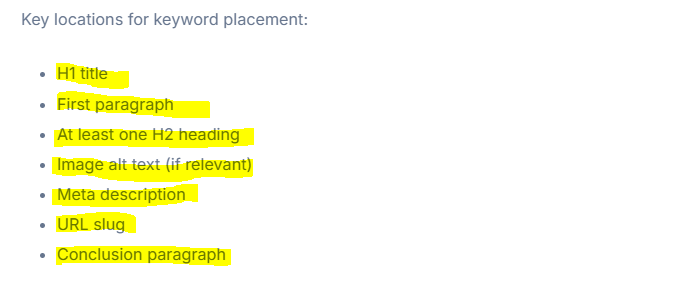
Your primary keyword should appear naturally throughout your content. For a 5000-word article, using the keyword 10 to 15 times is reasonable — roughly once every 300 to 500 words. Never force the keyword into places where it sounds awkward.
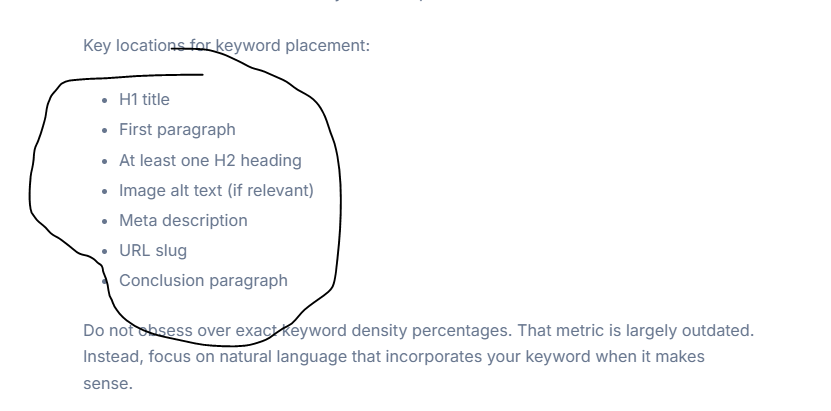
Key locations for keyword placement:
- H1 title
- First paragraph
- At least one H2 heading
- Image alt text (if relevant)
- Meta description
- URL slug
- Conclusion paragraph
Do not obsess over exact keyword density percentages. That metric is largely outdated. Instead, focus on natural language that incorporates your keyword when it makes sense.
Optimize Your Title Tags for Clicks
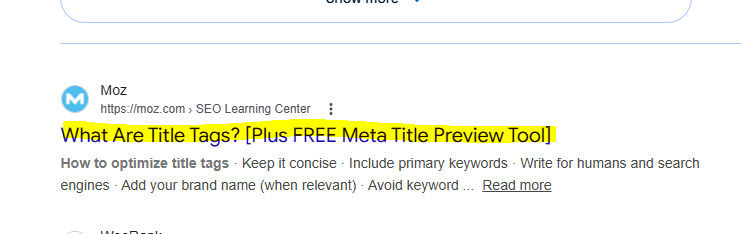
Your title tag is the clickable headline that appears in Google search results. It is often the first impression a potential visitor has of your content. A well-optimized title tag can double or triple your click-through rate.
Effective title tags typically include:
- Your primary keyword (preferably near the beginning)
- A compelling reason to click (e.g., “step-by-step,” “complete guide,” “with examples”)
- A length between 50 and 60 characters (so Google does not truncate it)
Examples of strong title tags:
- “SEO Content Writing: A 5000-Word Complete Guide for Bloggers”
- “How to Start a Blog in 2026: Step-by-Step for Beginners”
- “27 SEO Tools That Actually Work (Free + Paid)”
Notice how each title includes a keyword, a benefit, and specific detail. Avoid vague titles like “SEO Tips” or “Writing Advice.”
Use Related Words and Phrases (LSI)

Latent Semantic Indexing (LSI) is a fancy term for related words and phrases. Google does not just look for your exact keyword. It also looks for associated terms that confirm the topic.
For example, an article about “apple” could be about fruit or technology. If Google sees words like “iPhone,” “MacBook,” and “iOS,” it knows the article is about Apple the company. If it sees “orchard,” “pie,” and “harvest,” it knows the article is about apples the fruit.
To optimize for related terms, write naturally about your topic. If you are writing about SEO content writing, you will naturally use words like “keywords,” “backlinks,” “meta descriptions,” “search intent,” and “ranking.” Those are your LSI keywords. Do not force them — just write thoroughly and they will appear.
Use Multimedia In Your Content
Text-only content is less engaging than content that includes images, videos, infographics, and screenshots. Multimedia elements break up long passages, illustrate complex ideas, and keep readers on the page longer.
For SEO content writing, consider adding:
- Screenshots – Show examples of keyword research tools or search results
- Diagrams – Illustrate concepts like search intent categories or link structures
- Embedded videos – YouTube tutorials or explainers complement written instructions
- Charts – Present data or comparisons visually
Each image should have descriptive alt text that includes your keyword where relevant. Alt text helps visually impaired users understand images and gives search engines additional context.
Strategically Promote Your Content
Writing a great article is only half the battle. Promotion is the other half. Without promotion, even excellent content may never attract its first visitor.
Strategic promotion includes:
- Sharing on LinkedIn, Twitter, Facebook, and Pinterest (depending on your audience)
- Sending to your email newsletter subscribers
- Repurposing into smaller posts for other platforms (e.g., turning a blog post into a Twitter thread)
- Reaching out to websites that have linked to similar content and suggesting your article as a resource
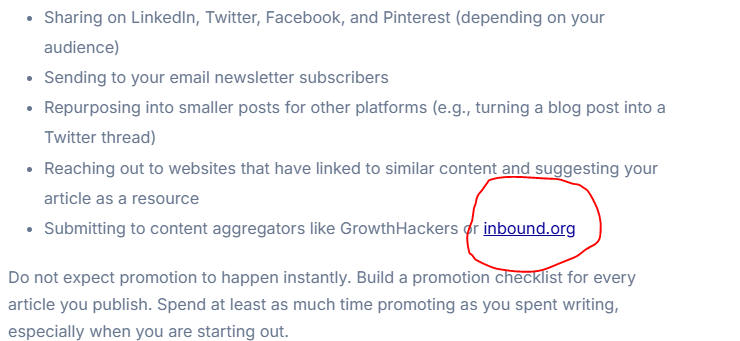
- Submitting to content aggregators like GrowthHackers or inbound.org
Do not expect promotion to happen instantly. Build a promotion checklist for every article you publish. Spend at least as much time promoting as you spent writing, especially when you are starting out.
Find Your Primary Keywords
Primary keywords are the main search terms you want each article to rank for. Every piece of content should have exactly one primary keyword. Trying to rank for multiple primary keywords in one article dilutes your focus and confuses search engines.
To find primary keywords, start with seed topics relevant to your niche. Then use keyword research tools to expand those seeds into specific phrases. Good tools for bloggers and content writers include:
- Google Keyword Planner – Free but requires a Google Ads account
- Ubersuggest – Free tier with limited searches
- Keyword Generator Tool (spelwise.com) – Free and user-friendly
- Ahrefs or SEMrush – Paid but very powerful
When evaluating a potential primary keyword, check three things: monthly search volume, competition level, and search intent. For new websites, prioritize keywords with lower competition even if search volume is modest. Ranking for ten low-volume keywords often brings more total traffic than ranking for zero high-volume keywords.
Identify Content Gaps
Content gaps are questions or topics that your competitors have not adequately covered. Finding and filling these gaps is a powerful SEO strategy.
To identify content gaps:
- List your top five competitors in your niche
- Visit their blogs and note what topics they cover
- Look for common questions in your niche that none of them answer well
- Search Google for your target keyword and look at the “People also ask” section
- Read competitor content and look for shallow explanations or missing subtopics
Once you find a gap, create a comprehensive article that fills it. Because competitors have ignored the gap, you face less competition while providing unique value to readers.
Choose Your Secondary Keywords
Secondary keywords are related terms that support your primary keyword. They help you write comprehensively and give search engines additional context.
For an article with the primary keyword “SEO content writing,” secondary keywords might include:
- On-page SEO checklist
- Keyword research tools
- Search intent optimization
- Content structure best practices
- Meta description examples
Sprinkle secondary keywords naturally throughout your article, especially in subheadings. Do not force them. If a secondary keyword does not fit, leave it out.
Satisfy Search Intent
Satisfying search intent means delivering exactly what the user wants based on their query. If someone searches “how to bake bread,” they want a recipe with step-by-step instructions — not a history of bread or an essay about wheat farming.
To satisfy search intent:
- Analyze the top 10 Google results for your target keyword
- Note the format (listicle, how-to guide, product review, comparison, etc.)
- Identify the common subtopics that all top results cover
- Check the content depth (how many words, images, examples)
- Create something equal or better in quality
Never ignore search intent to be creative. If the top results are all listicles, write a listicle. If they are all long-form guides, write a long-form guide. Fighting intent is a losing battle.
Create Quality Content
Quality content is the foundation of sustainable SEO. Search engines become smarter every year. Shortcuts that worked in the past — keyword stuffing, buying links, spinning content — now result in penalties or complete invisibility.
Quality content has these characteristics:
- Accurate – Factually correct and up-to-date
- Original – Brings new insights or perspectives, not just rewritten existing content
- Well-researched – Cites sources, includes data, shows expertise
- Well-written – Proper grammar, clear sentences, logical flow
- Useful – Solves a real problem or answers a real question
Do not publish content just to publish content. Every article should earn its place on your website. If you would not confidently show it to an expert in your field, it is not ready.
Use Keywords Naturally
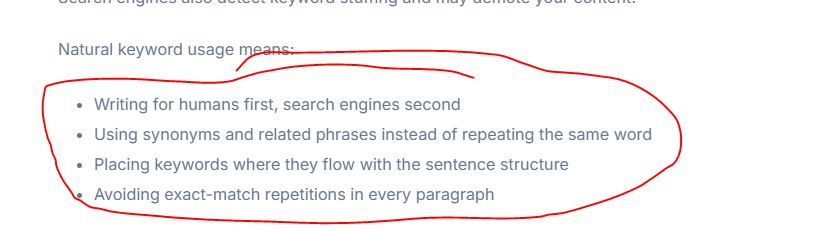
Forcing keywords into your writing creates an unnatural, robotic tone that readers hate. Search engines also detect keyword stuffing and may demote your content.
Natural keyword usage means:
- Writing for humans first, search engines second
- Using synonyms and related phrases instead of repeating the same word
- Placing keywords where they flow with the sentence structure
- Avoiding exact-match repetitions in every paragraph
Read your content aloud. If a keyword placement sounds awkward or forced, rephrase the sentence. It is better to rank slightly lower for a keyword than to publish unreadable content.
Structure Content with Subheadings
Subheadings break your content into scannable sections. Most online readers skim before deciding whether to read deeply. Clear subheadings help them find the specific information they need.
Use H2 for main sections and H3 for subsections within those sections. Do not skip heading levels (e.g., jumping from H1 to H4). That confuses both screen readers and search engines.
Each subheading should be descriptive. Instead of “Benefits,” write “Three Benefits of SEO Writing for Bloggers.” Descriptive subheadings also give you additional opportunities to include keywords naturally.
Make Your Content Easy to Read
Readability affects both user experience and SEO. If your content is difficult to read, people leave quickly. That high bounce rate signals low quality to search engines.
To improve readability:
- Keep sentences short (15 to 20 words on average)
- Keep paragraphs short (two to four sentences maximum)
- Use bullet points and numbered lists for sequences or comparisons
- Add transition words between paragraphs (however, therefore, for example)
- Avoid jargon unless your audience expects it
- Use active voice instead of passive voice where possible
Readability tools like the Hemingway Editor or Yoast SEO’s readability analysis can help you identify problematic passages. Aim for a readability level appropriate for your audience. General audiences usually require a 6th to 8th grade reading level. Technical audiences can handle higher levels.
Include Multimedia Elements in Your Content
As mentioned earlier, multimedia elements make content more engaging and shareable. Beyond images and videos, consider adding:
- Tables – Compare products, features, or data points
- Infographics – Summarize complex information visually
- Audio clips – Provide a podcast-style summary for auditory learners
- Interactive elements – Calculators, quizzes, or assessments (more advanced)
Each multimedia element should add value, not just decoration. A generic stock photo of someone typing adds nothing. A screenshot of a keyword research tool in action adds real instruction.
Add Internal Links
Internal links are hyperlinks that point from one page on your website to another page on the same website. They help search engines discover all your content and distribute authority across your site.
Best practices for internal linking:
- Link to relevant older content from new content
- Use descriptive anchor text (e.g., “read our complete guide to keyword research” instead of “click here”)
- Do not overdo it — one internal link every 300 to 500 words is plenty
- Link to pillar pages or cornerstone content more frequently
- Avoid linking to the same page multiple times in one article
For bloggers, a simple internal linking habit is to link to three to five older posts in every new article. Over months and years, this creates a web of interconnected content that search engines love.
Link to High-Quality External Resources
External links point to other websites. Many beginners worry that linking to other sites will send visitors away and hurt their rankings. In reality, the opposite is true. Linking to high-quality, authoritative external resources shows search engines that your content is well-researched and connected to the wider web.
Good external linking targets include:
- Original research or data sources (e.g., government statistics, academic papers)
- Industry authority websites (e.g., Moz for SEO, HubSpot for marketing)
- Definitions for specialized terms
- Complementary resources that expand on a subtopic
Use external links sparingly — one or two per 1000 words is usually sufficient. Ensure the linked sites are reputable. Linking to spammy or low-quality sites can harm your own reputation.
Optimize Your Content for Featured Snippets & AI Overviews
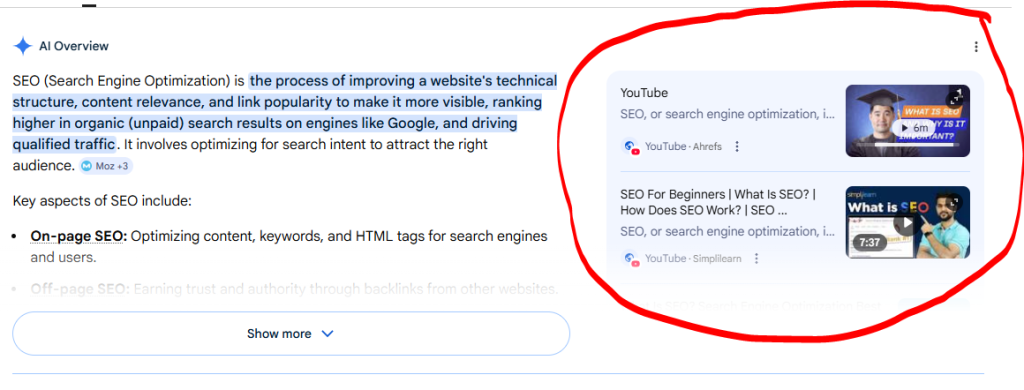
Featured snippets are the short answer boxes that sometimes appear at the top of Google search results. AI Overviews are AI-generated summaries that appear for some queries. Optimizing for both can drive significant traffic.
To optimize for featured snippets:
- Identify keywords that trigger snippets (use tools like SEMrush or Ahrefs)
- Answer the question directly and concisely within the first 100 words
- Use paragraph, list, or table format depending on what Google shows
- Mark up your answer with appropriate HTML (e.g., <ul> for lists)
For AI Overviews, focus on creating authoritative, well-structured content that AI systems can easily summarize. Clear headings, factual accuracy, and comprehensive coverage all help.
Create an Optimized Title Tag
The title tag appears in browser tabs and search results. It is one of the most important on-page SEO elements.
An optimized title tag:
- Contains your primary keyword (preferably at the start)
- Is between 50 and 60 characters
- Includes a power word or value indicator (e.g., “Complete,” “Ultimate,” “Step-by-Step,” “Free”)
- Accurately reflects the content
- Differentiates from competitor titles
Write several title variations before choosing one. Ask yourself: “If I saw this title in Google, would I click?” If the answer is no, keep working.
Write a Compelling Meta Description
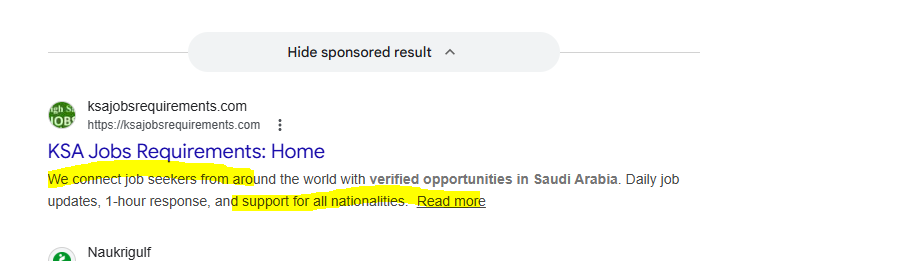
The meta description is the short summary that appears below your title in search results. While not a direct ranking factor, a compelling meta description significantly improves click-through rate.
Best practices for meta descriptions:
- Keep between 150 and 160 characters
- Include your primary keyword naturally
- Clearly state what the reader will gain
- Add a call to action (e.g., “Learn how,” “Discover,” “Get started”)
- Make each meta description unique (no copying from other pages)
Do not leave meta descriptions blank. Google will auto-generate something, but it often looks messy or irrelevant.
Optimize Your URL Slug

The URL slug is the part of the URL after the domain name. For example, in https://example.com/seo-content-writing-guide, the slug is seo-content-writing-guide.
Optimized slugs are:
- Short (three to five words maximum)
- Descriptive
- Lowercase
- Use hyphens between words (not underscores)
- Contain the primary keyword
Avoid slugs like ?p=123 or blog-post-45. They tell readers and search engines nothing about the content.
Promote Your Content
Promotion was covered earlier, but it deserves repeating. Promotion is not optional. Even the most perfectly optimized article will not rank if no one knows it exists.
Create a promotion checklist that includes:
- Social media posts (schedule multiple at different times)
- Email newsletter announcement
- Outreach to mentioned brands or experts
- Submission to relevant communities (Reddit, LinkedIn groups, Facebook groups)
- Repurposing into video, infographic, or slide deck
Consistent promotion separates successful bloggers and content writers from those who give up after six months of publishing into silence.
Examples of Effective SEO Writing
While this article avoids full case studies per your instructions, it is worth briefly mentioning well-known examples of effective SEO writing so you can study them independently.
Spel Wise Guide to SEO – The website spelwise.com offers practical, user-friendly SEO guides that rank well for various informational keywords. Their content balances depth with readability.
American Kennel Club How-to Guide – The AKC publishes detailed guides on dog training, health, and breeding. These articles rank for highly competitive keywords because they combine authority, comprehensiveness, and clear structure.
Studying how these and other successful sites write, structure, and optimize their content will accelerate your learning faster than any single article.
SEO Tool to Optimize Your Content for First Page Rankings

You do not need dozens of expensive tools to succeed. Focus on a few reliable ones. Here is a recommended starter set:
- Keyword research – Free Keyword Generator Tool at https://spelwise.com/free-keywords-generator/
- Spell checking – https://spelwise.com/ (also offers URL encoding/decoding tools)
- On-page SEO analysis – Yoast SEO or Rank Math (free WordPress plugins)
- Competitor research – Google itself (search your keyword and analyze top results)
- Backlink checking – Google Search Console (free)
For more advanced needs, refer to 50+ Best SEO Tools (Free + Paid) available at https://spelwise.com/50-best-seo-tools-free-paid/. That resource categorizes tools by function and budget, helping you choose what fits your needs.
How Much Money Freelance SEO Content Writer Can Make

Many bloggers and content writers wonder about earning potential. Freelance SEO content writer income varies widely based on experience, niche, and business model.
Typical ranges:
- Beginner – $0.03 to $0.10 per word ($30 to $100 per 1000 words)
- Intermediate – $0.10 to $0.25 per word ($100 to $250 per 1000 words)
- Advanced – $0.25 to $1.00+ per word ($250 to $1000+ per 1000 words)
SEO content writers with specialized knowledge — legal, medical, finance, technical B2B — command higher rates. Writers who understand how to optimize content for conversions (not just rankings) earn even more.
Some SEO content writers charge per project instead of per word. A comprehensive 5000-word pillar page might cost $500 to $2000 depending on research and optimization requirements.
The highest earners combine writing with SEO consulting, offering content strategies, keyword research, and performance analysis alongside writing services.
How to Become an SEO Writer?
Becoming an SEO writer does not require a degree or certification. It requires learning, practicing, and building a portfolio.
Follow these steps:
- Learn the fundamentals – Read guides like this one. Understand keywords, search intent, on-page optimization, and basic HTML.
- Start a blog – Practice SEO writing on your own website. There is no better teacher than publishing and seeing real results.
- Analyze what works – Study top-ranking content in your niche. Reverse-engineer their structure, length, and keyword usage.
- Write every week – Consistency matters more than perfection. Aim for one well-researched article per week.
- Learn basic tools – Master one keyword research tool and one on-page SEO tool before adding more.
- Offer low-cost or free work initially – Write for a friend’s blog, a nonprofit, or your own site to build samples.
- Create a portfolio – Showcase 5 to 10 articles with metrics (traffic, rankings, shares) if available.
- Apply for jobs or pitch clients – Start on platforms like Upwork or ProBlogger, or pitch directly to websites you admire.
Within six to twelve months of consistent effort, most determined learners can land paid SEO writing work.
Basics of SEO Writing
Before ending this guide, here is a quick refresher of the absolute basics every SEO writer must know:
- Every article needs one primary keyword
- Your primary keyword belongs in the title, first paragraph, subheadings, URL, and meta description
- Write for humans first, then optimize for search engines
- Content must match search intent
- Longer, comprehensive content generally ranks better than short, shallow content
- Internal and external links improve SEO
- Promotion is as important